Why I Didn't Use AI, and What if I did?
- Jared
- Nov 13, 2025
- 5 min read

Updated: Nov 14, 2025
AI was not used to generate this writing or the visuals included.
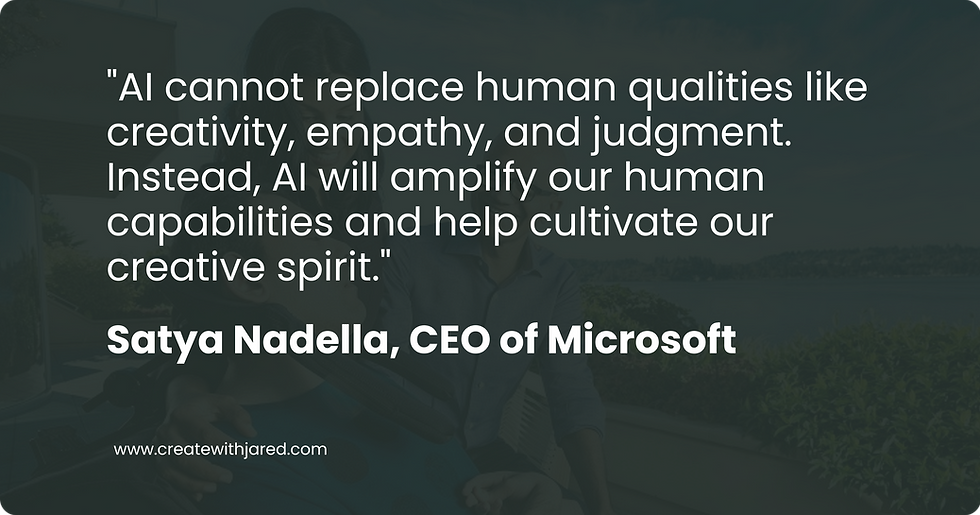
The main purpose of my portfolio is to display my work and professional capacities in a user friendly digital environment. In short; I wanted hiring managers and Marketing pros to see the best of what I have to offer at a glance. If I utilized AI for the writing and imagery appearing on my site, am I presenting the skills and abilities I've learned, or am I just showcasing my ability to use a chat bot to get to an end result? The question alone nagged at me, because each path presented an equally interesting proposition to my visitors. Ultimately, I decided to limit my use of AI entirely while designing the website and writing the copy. Even if the words you're reading now have been placed here, intentionally, by me. This choice reflects my current philosophy on the latest AI trends;
"Use AI as an amplifier, learning partner, and automation assistant. Don't use it as a crutch." - Jared Marrero
This summary is informed by a variety of market leaders, each with their own particular focus on the technology's impact, and my own experiences utilizing AI in a professional capacity. Whether you're using an LLM, image/video/audio generation model or automation services powered by AI; you should be using them strategically to magnify the power of your pre-optimized marketing funnel and heighten the innate abilities of your marketing team. AI won't make your content perform well just because you told it to, and it certainly will not teach you anything unless you specifically use it to build knowledge.

"Let AI write your email reminder, for example, but don't use it as a first draft anyway. Don't let it write the first draft of your email newsletter. If what you wanna do is connect your human heart with the recipient's human heart...I think we need to be very intentional about how we use it and not just use it as a default." - Ann Handley

"Use AI tools extensively for execution of repetitive marketing tasks like content creation, data analysis, campaign management to scale productivity" - Seth Godin

"AI won't replace humans—but humans with AI will replace humans without AI" - Gregg Kober, Harvard Business Impact
With the above advice in mind, I decided to create my website from scratch using Figma and Wix Studio to quickly create and optimize visual assets. I began with a rough wireframe designed in Figma, iterated to create final pages, finalized copywriting, then exported Figma assets using Wix Studio's handy plugin. There is a bit of AI tech involved in transforming static Figma assets into interactive containers and stacks. This reaffirms my opinion, however, that AI will simply be used as a tool for efficient creative workflows just as much as it is used for strategy development and automating simple processes. Many tools creative marketers use today have implemented their own AI features. While learning how to optimize your creative endeavors using AI is imperative, the technology shouldn't be used to generate any form of final content unless it is doing so with a human reviewer checking in to make sure hallucinations and incorrect information are kept to a minimum.
It is for this reason that none of the actual content or writing on my site is generated or edited by AI. My portfolio is a showcase of my abilities, not a showcase of how well I can use new technology. For this, employers can visit several other pages on my site to discover my exposure and professional use cases with these tools. I'm displaying an expertise that has been developed over eight years, while communicating the value I bring to a team when working with AI.
What about AI as a teacher? This is one of the most powerful uses of the technology today. Instead of allowing AI to do all of the work for you at a mediocre rate, using the tools to empower your developed skills is a fantastic way to increase the value it provides. For example; marketers seeking to create custom landing pages would have to sift through pages of WordPress or Adobe Experience Manager forums in order to build a basic page for their promotion.
Now with the power of AI, you can dive head first into semi-advanced marketing projects like these, with instant contextual advice from your LLM partner. You could communicate the project's exact goals, challenges and your own abilities to receive exact directions for creating something of quality. Then, using your foundational skills in communications and problem solving: you can drive your learning in a way that fits you the best. This is especially useful for those who learn by doing, or self teachers, as your LLM can act as a custom guide without getting in the way of your own experience using a new tech.
Instead of spending thousands on courses or hours learning skills that simply support our marketing strategy. One could decide to spend the day learning how to send HTML emails with the help of an LLM, and by the end of the twenty four hour period, they'd have a much better understanding of how to use the process for their advantage. Once you have an understanding of the actual products you're creating, you can automate these processes with AI and responsibly scale your new skills to match the needs of your business or brand.
This philosophy can be scaled to quickly educate and prepare your entire department for new initiatives that once required dozens of engineers and creatives. Even more impressive, AI can introduce an entirely new form of cross functional collaboration as employees begin to learn how other aspects of their business can effect their current project, with insights from an enterprise level LLM that stores the collective data and uses it to customize their experience. This is institutional knowledge sharing on an entirely new level, and I couldn't be more excited to see how marketing leaders leverage this strategy in 2026 and beyond.
What if I used AI at A Small Business or Enterprise?
So what if I'm tasked with creating websites and landing pages at scale? My workflow would be much different, as my priority wouldn't be showcasing skills that the end user doesn't really care about; I'd use a modern stack to quickly generate my website, correct the design with some design input, and most importantly connect this web page to a constant data source for personalized or updated information. Below you can find a loose plan and list of tools I would use for future projects with established brands:

AI is here, and your candidates' ability to utilize or learn artificial intelligence tools is paramount for your department's future success. Use this handy free tool to compare your candidate's AI knowledge at a glance.
Interested in more? Contact me today to discuss AI's impact on your business and my vision for the future of content marketing.

Comments